Tuesday, November 18, 2014

MB Caschetta's Guide to Books & Booze


Time to grab a book and get tipsy!

Back by popular demand, Books & Booze, originally a mini-series of sorts here on TNBBC challenges participating authors to make up their own drinks, name and all, or create a drink list for their characters and/or readers using drinks that already exist. 


Today, MB Cashetta shares a deleted scene from her novel Miracle Girls, which released November 11th. Too funny that it's also the booziest scene!


~~~~~~~~~~~~~~~~~~~~~~~~~~~~~~~~~~~~~~~~


An extra-dry gin martini on the rocks is the drink. Barely even a drop of Vermouth. This is what 10-year-old Cee-Cee Biancos father drinks. Its also, coincidentally, what my father drank. The other recurring beverage in Miracle Girls is Benadryl, which Cee-Cee’s family constantly feeds her to take the edge off her visions. In this way, father and daughter are equally stoned throughout the first third of the novel.

The Kirkus review of Miracle Girls points out the basic set up:

In upstate New York, young girls go missing, nuns are revolting, Nixon is resigning, and young Cee-Cee Bianco has visions of the Virgin Mary in this polished debut novel. Ten-year-old Cee-Cee has a broken family: Father Frank goes on drunken benders, mother Glory runs away for weeks at a time, middle brother Roadie is wracked with guilt over his burgeoning homosexuality, and eldest Anthony is a little off. Cee-Cee and Baby Pauly cling to each other, as close as twins.

The scene that got cut during the final edit, in which Frank is in a bar getting sloshed, and Cee-Cee is lying on a pool table drowsy with allergy medicine. Cee-Cees mother has taken off again, and Frank has paid the local cabbie to pick his daughter up at home (it is Christmas break) and drop her off at the Blanches Iron Door, the bar he frequents. She has a fever:

Frank has Cee-Cee lie down on an empty pool table, bunching up his coat for a pillow. She can see the shiny jukebox, squat and solid with its silver chrome and bright blue lights, behind the mismatched tables and chairs shoved onto the dirty square of plastic flooring. If her head didnt hurt, shed get up and use Blanches secret stash of quarters.
The bar is empty.  Under Cee-Cees limp body, the green felt is comforting.
Frank takes a barstool. Gin with a splash, Blanche. Extra dry.
No kidding. Blanche takes a wad of bubble gum from Cee-Cees mouth and feeds her two baby aspirin, covering her with a red-and-white checkered tablecloth, plastic on one side, fuzzy on the other.
I feel hot, Cee-Cee tells her.
Well course you do, baby, Blanche says. Thats why Old Blanche never prays.
Over Blanches pink turtleneck, a red sweater is stretched tight. Near one shoulder, one reindeer says Ho, Ho, Ho in white stitching.
Close your eyes now, bunny. Blanche smooths her hair. Dont go worrying yourself about Jesus, Mary and Joseph. They can take care of themselves.
            Frank produces a bottle of the magic pink liquid and tosses it to Blanche. Give her some Benadryl.
You cant just go around drugging your kid, Blanche says. And then you wonder why she hallucinates angels and talks to God?
It calms her down. Frank shrugs.
Blanche sighs, gives Cee-Cee a sip from the bottle.
Under the dark beams of the old bank ceiling, Cee-Cee is swimming in and out of a heavy sleep, catching snippets of the conversation.
            “It’s this damn economy…And some new kind of bomb…”
            “Hell of a thing…” Blanche snaps. “A bomb that can drop itself.”
            Cee-Cee kicks off the tablecloth, uncomfortable.
             “I grew up on that base,” Frank is saying.
            “…fancy severance package can’t be all bad.” Blanche comes around from behind the bar and touches Cee-Cee’s forehead, checking the fever.
            Cee-Cee tries to tell Blanche about the names Glory called Frank over Christmas dinner: Whiskey-dick, Asshole, Bum.
            “What’s the matter? Can’t get comfy, kangaroo?” Blanche flicks on the TV. “Try the boob tube for awhile. That always puts old Blanche right to sleep.”
            A trio of violins from a daytime soap opera fills the room. It’s not one Cee-Cee knows. A man with a beard tells a blond woman, “Love will kill you.”
            Frank and Blanche stare at the TV as a newscaster comes on with a special report about the girl missing since Christmas Eve.
            A photograph comes on screen: a girl with wavy red hair, freckles, a gap in her smile where Cee-Cee can see the faintest flash of tongue. The reporter describes the pink sweater the girl was wearing when she disappeared.
            “Sure are a lot of sickos around here,” Frank says.
            Kidnapped, says the newscaster somberly.
            “Shame,” Blanche says. “More girls go missing right here in this part of New York State than anywhere else in the country. Heard it on the radio.”
            “Yeah.” Frank says.
            Next on the T.V., a bunch of Vietnam protesters with long hair shout at the camera. They hold up two-finger peace signs and shake them at the screen.
            A reporter interviews a nun in full habit carrying a protest sign about the war.
            “What’s this?” Frank says. “The Flying Nun? She looks like Sister Bertrille.”
            “Those Sisters from Our Lady of Sorrows are always up to no good,” Blanche says. ““Chaining themselves to the gates of the military base when they’re supposed be teaching long division and catechism. Vietnam protesters. How is that God’s work?”
             “Who do they think is protecting their sacred asses from communism?”
            “Aren’t they friends with Marina? The Sisters of Something-or-Other.”
            Frank can’t stand God or Nonnie. “Glory’s mother is a holy roller.”
At the commercial Blanche lowers the volume and smiles at Cee-Cee. “My Norbie sure is going to be glad to see you lying there like a princess when he gets home.”
The green fuzz beneath Cee-Cee’s body is soft. She falls into a dream about red-haired girls in pink sweaters.

*
As the afternoon wears on, the bar is shrouded in an eerie quiet. Mike hasn’t set foot in a church for years­­, but sometimes the place seems vaguely hallowed to him.
            He lifts his glass: “Amen.”
This moment will soon be ruined by the onslaught of daily drunks and military men from the lab with their briefcases and secrets for a liquid lunch: 9-to-5ersnot his category any more.
Having Cee-Cee nearby makes him feel strange, but also good.
No one prepared him for being a father. He is plagued by the idea that he created four little strangers out of his own body. He thinks the boys look like him, and Cee-Cee is the spitting image of Glory, and therefore of Glory’s mother.
When he and Glory were sweethearts, before they’d even graduated high school, Mike worked in the Caxton Laboratory. It was still called Romeville Labs then. He was the youngest nonenlisted technician in the whole history of the base; younger even than his father was when he first worked there.
After Mike and Glory got married, they moved into a tiny efficiency apartment on the compound. It had a hot plate and a bathtub in the kitchen. When Anthony was born, they upgraded to a family unit. Mike was happy with just the three of them. Things got crowded when Roadie and Baby Pauly came along, but he still somehow managed a pretty good mood.
But nothing was ever good enough for Glory. She accused him of not loving anyone but Anthony. Said he didn’t try hard enough with his other children. Eventually she found the old ramshackle firetrap they live in now. She loved how it was snuggled between two roadways and a creek. Mike thought it was a bad idea.
“The thing with kids,” he tells Blanche, “is that everything ends up being your fault.”
Blanche pours him another drink, fat fingers gripping the glass still steamy from the dishwasher. “I hear Anthony’s in trouble again.”
Mike grunts.
She places the rest of the glasses upside-down on a little shelf behind her. “My Norbert says Anthony will flunk a third time if he doesn’t watch out.”
What does Fat Norbie know? Mike hates being reminded that his kids arent winners. Hes got problems of his own.
“If there's one thing my Norbert knows, it’s flunking. Two birthdays in the eighth grade already; he’s almost 16. Anyway, I enrolled him in that special school, the one with the uniforms and the aides. Starts in January.”
“For Christ’s sake!” Mike is getting drunk now. “Why the hell did you do that?”
“He’s slow upstairs when it comes to thinking.” Blanche stares off toward the window. “Those special programs help.”
“They just need to give a person some space.”
“There’s not that much space in the world.” Blanche chews on a toothpick. “I’m doing something real for Norbert. You should do the same for your kid. They can't spend their lives in high school, now can they?”
The wind howls. Both Mike and Blanche turn to look at the white outside.
 “Maybe if we’d stayed on base,” Mike tells Blanche, slurring, “it wouldn’t have been so easy for the top brass to let me go.”
Glory ended up pregnant with Cee-Cee when they thought she couldn’t possibly conceive again. That’s when all the trouble started. Of course Cee-Cee was a girl, which was more than Mike could handle.
Counting the inventory, Blanche marks down the numbers of bottles in a green ledger. “What’s the matter now?”
Mike lifts his head. “Did I ever tell you about that little intern over at Romeville Free’s gymnasium? Man, was she something.”
“You should leave them young ones alone. “ Blanche sighs. “You told me she stopped taking your calls.”
He chuckles. “The secretary kept saying she was on lunch duty, and I’d say:
‘It’s 3:30! What damn time do these kids eat?’”
Blanche smiles. “She got your number right quick.”
 “I always say the wrong thing to women.”
Cee-Cee feels the gust of cold air, a nervous chill that swirls into the warm bar.
 “I have to hand it to you, Mike,” Blanche clucks her tongue. “You have some lousy luck with the opposite sex.”
Blanche’s points over Mike’s shoulder toward the darkened door where Glory is brushing snow off her coat.
“Oh shit,” Mike says.
Glory’s voice: “How drunk are you, Mike?”
Cee-Cee tries to sit up, but Mike’s pink syrup has her feeling slow.
“I hope you’re not too drunk to hear what I have to say.” Glory says, “Because I’m done with you, Mike. I’m leaving.”
Blanche clinks some bottles together and clears her throat. “I’ll be in the back room, folks; inventory.”
Mike stumbles over to the jukebox, taking the conversation to the far end of the room. Cee-Cee has to strain to make out the words.
 “C’mon, Glory,” Mike pleads. “Give me a break.”
“You’re here all day long instead of looking for work!"
Down on my luck is all. I can change.turn it around.
Outside, the wind whips against the building.
Glory’s voice goes soft. “Every person in Oneida County has been laid off from that stupid lab. Who cares? You can get another engineering job. What about Xerox, or even Kodak?  Moonie's been there a long time; he'll help you get a job. Anyway, what kind of work is it anyway? Figuring out better ways to kill people?”
“I need you, Glory.”
“Think about your children,” she says. “What are they supposed to do while you’re throwing everything away?”
Mike cries, not quiet and embarrassed the way most fathers probably cry, but loud with long howling noises coming from his throat.
Cee-Cee tries to roll over, but nothing moves.
Tears muffle Glorys voice. You need a shower, Mike.
Cee-Cee knows that Glory is brushing her fingers through Mikes hair, a sign that she is about to forgive him. The air shifts again, this time almost imperceptibly, from tense and angry to unbearably sad.
Look, heres a twenty. Okay? Glory says. Lets go home, right now. We can call a cab.
Ill get a new job. Mike sounds happy. Well do Christmas all over again, the right way. Things will get better. Let me buy you a drink: We can toast to second chances.
All right, Mike.
Blanche lugs a carton out of the old bank vault storeroom with its wall of safety deposit boxes, plus the little black gun Blanche always talks about. She keeps it in in the first box on the bottom row. Says shell use it if theres any funny business at her bar.
I have to step outside for a minute, Glory says. Let go of my coat, Mike. Just one minute. I have to take care of something. Then Ill be back, and Blanche will call a cab, and well all go home.
“Hurry,” Mike says.
Glory comes over to Cee-Cee on the pool table and gives her a big hug with plenty of kisses.  “Hi, Baby. Are you sick again? I’m sorry about this morning. But now we’ll all go home together, okay?”
Like magic, Cee-Cee’s eyelids unstick. “Hi, Glory. I feel better now.”
“Back in a flash,” Glory promises as she breezes back toward the door.
Blanche crosses the room, stopping to peer through the diamond cutout window of the front door after Glory; she holds a few bottles of whiskey in her hand.
Mike starts talking as if nothing happened. “Damndest thing, Blanche, I had to pee like the devil for the last half hour. And now–––nothing!”
Blanche snorts.
“Poor me, poor me.” He slaps Roadie’s money on the bar. “Pour me a drink!”
Blanche comes around the backside of the bar with a bottle of Beefeater. She collects Mike’s money and fills his glass.
Mike works his mouth into a dry smile.
“Glory gone?” Blanche pours to the rim.
Mike bares his teeth at the whiskey. “Gone is exactly what Glory is.”

*
It gets dark a few minutes before the dinnertime rush. Blanche opens the back door to let her son in. 
Norbie walks fast on the heels of a girl with ponytails and scraped knees. He pulls off his coat and scarf, giving his mother a kiss, then looks across the room. “Cee-Cee! Have you been here praying?”
“I’m sick.”
His looming rubbery face is red from the cold and big as a moon.
“Oh no!” He curls his long pink tongue and rubs his hands together in a special coded motion above his head, as if applying some magic lotion. “This is my best friend, Mary Margaret. She’s real smart. Aren’t you, Mary Margaret? She lives five houses over.”
The girl eyes Cee-Cee’s pajamas and hair. “You’ve been lying there all day? On a pool table?”
Feeling her fever lift, Cee-Cee pops up on an elbow. “Yeah, so?”
“What if someone wanted to play and knocked you off with a cue stick?”
“Hasn’t happened yet,” she says.
Norbert exhales a long, sour breath. “The angels watch over Cee-Cee.”
Mary Margaret twists her cherry mouth into a frown. “What’s that mean?”
But Cee-Cee is not about to tell her anything. She just smiles.
Mary Margaret is skinny and has two jagged front teeth growing in crooked. Her face is small and mouse-like, sharp but pretty, and splattered with freckles. Her brown hair is tied into matching braids behind each ear.
“What grade are you in?” she asks. “Second?”
“Fourth,” Cee-Cee says. “They almost skipped me to Fifth but I wanted to stay with my brother.”
“Public school?”
Cee-Cee nods.
Norbert watches them. “Mary Margaret goes to Catholic school with the nuns from church.”
“My Nonnie lives across from Our Lady,” Cee-Cee says. “She’s friends with the Mother Superior there.”
“Mother Stephen!” Mary Margaret seems vaguely impressed. “She’s the school principal. Do you know she has burns on most of her body? If you get on her good side, she’ll show you the scars—they’re real bad.”
Nonnie has Mother Stephen over for tea and cookies when Cee-Cee and her brothers are visiting, but she has never seen any scars. “I think she’s pretty.”
“Her face, sure, and she's younger than most of them.” Mary Margaret turns to Norbert. “You know what those Sisters are called, don’t you?”
Norbert’s eyes get big. “The Sisters of Christ’s Most Precious Wounds?”
The Spooky Sisters!” Mary Margaret says. “And I’ll tell you what: they are a big pain in my ass.”
Laughing, Norbert lumbers to the bar to pat Mike’s back, as if he’s the genius responsible for all his good luck. “Cee-Cee’s here! I love Cee-Cee.”
“She’s our girl.” Mike raises his glass.
Mary Margaret studies Cee-Cee. “Next year, I’m going to get a pair of platform shoes and wear them at school. Let those holy Wounds try and stop me!”
“Glory twisted her ankle wearing platforms once. She had to rest her foot in a bucket of ice.”
“So?” Mary Margaret says. Then, curious: “Who’s Glory?”
Blanche signals to them. “Dinner upstairs—then I’ll take you girls home. Mike’s in no shape to do anything except sleep it off in the store room.”
Blanche never lets children sleep over, but she will feed just about anyone.
A house on two main highways and a creek that floods every year is her idea of bad news, she always says—and she doesn’t like boys running around like wild Indians, either. She doesn’t let Norbert go to Cee-Cee’s house too often.
Dragging his bad leg, Norbert makes a path through the crowd toward the arched doorway behind the bar that leads to the little apartment above. The Iron Door is alive with customers and music as the afternoon lull draws to a close.
“One of you lesser drunks watch the bar for me.” Blanche tucks the cash box under her arm. “I’ve got to feed these kids.”
“Unwise calling your customers drunks,” Mike says.
“Nah.” Blanche looks around. “You know I think of you as folks with cancer, sorry cases, except some of you still got hair.”
Laughter ripples through the room. It is always cheerful at the beginning of a shift. But these are the very same men, Cee-Cee knows, who will be hunched and silent at the end of the night.
One guy comes around to the back of the bar. “You love us, Blanche. You know you do.”
Blanche leans into the guy. “Pretend to care, my husband always said, may he rest. That’s all people want. And that’s what I do: pretend.”
The guy pushes a dollar bill into Blanche’s psychedelic sweater. “Damn good bartender, your husband was.”
Blanche slaps the guy’s hand away, but pinches the dollar. “What’s this for?”
“For your kid. Because he’s…simple –– or something.”
“Oh, he’ssomething all right.” She beams.
Blanche herds them up the stairs to the cramped apartment above. “The first rule of alcohol is never get close; you’ll only get hurt.” She nods at Cee-Cee and Mary Margaret. “The second is: never try to fill up a drunk; it can’t be done.”
Holding Norbert’s damp meaty hand, Cee-Cee watches the mole at the corner of Blanche’s mouth disappear and reappear as she talks. She knows what Blanche means: Most of the time, Mike is as hollow as a drum.
Norbert pulls both Cee-Cee’s and Mary Margaret’s hand to his chest, rubbing them together. Blanche stoops, weighed down by her enormous body.
“Can Mary Margaret eat over too?” Norbert asks. He stops on the landing, dropping their hands, so he can rub his knuckles together in the strange familiar motion at his forehead.
“Don’t see why not.” Blanche heaves her body up the steps. “‘Less Mary Margaret’s mother is making dinner at her home?”
“Mom’s got a new baby,” Mary Margaret reports. “No dinners for a while.”
“Dear heavens, another one?” Blanche squeezes by to unlock the apartment door. “Where does that woman get the heart?”
Mary Margaret shrugs. “She stays in her room.”
“You must be a comfort to her.”
“I’m the only one who’s made it so far,” Mary Margaret says. “We’re not even naming this baby until we’re sure he's going to live."
She looks at Cee-Cee meaningfully.
In a flash, Cee-Cee sees the little baby graveyard behind Mary Margaret's house, matchstick stones rising up to mark the graves. She counts: one, two, three, four of them.
Blanche pats Mary Margaret’s bony arm, then caresses Norbert’s cheek until he unfurls his long pink flag of a tongue and wags it outside his mouth.
“Well, I hope you like soup, Mary Margaret, because we’ve got to get our little Cee-Cee here back on her feet.”
“Okay by me,” Mary Margaret says.
Norbert rests his big moony face on his mother’s breast, making Cee-Cee’s heartache exactly in the middle.

In Blanche’s apartment, they turn on the lights, start a fire in the stove, and open several cans of soup. Blanche parks Cee-Cee on the sofa with an afghan and flips on the local news.
On a tiny black and white set that looks like it was made for a doll, the newscaster gives an update on the kidnapping. A piece of pink sweater was found on a chain link fence down by the railroad tracks.
The missing girl’s name is Eileena Brice Iaccamo.
Blanche clucks her tongue. “Don’t those Iaccamo kids go to Catholic school with you at Queen of Sorrows, Mary Margaret?”
“A bunch do,” Mary Margaret answers. “There’s about a million of them, all with Irish first and middle names. The older ones go to public school at Romeville Free.”
“Missing girl’s 14, the paper says. She must be up at the high school.”
Mary Margaret hovers close by, waiting for Cee-Cee to look up from the T.V. “Last year this girl in my neighborhood disappeared. In the spring, they found the snow piled up right over a set of fresh bones. Turned out to be a dead dog though. She was never heard from again.”
Cee-Cee chews a fresh piece of gum.
Mary Margaret watches for signs of weakness and comes up with a lie: “She was my best friend.”
Norbert chants in a loud voice: “They have to find this missing girl. They have to find her.”
Cee-Cee can see someone pulling a girl out of a ditch. “Jesus brought St. Martha’s brother back to life. Maybe you should pray for her.”
Mary Margaret bites her nails and frowns. “You don’t believe that crap.”
“Why not?” Cee-Cee says.
Mary Margaret thinks this over. “We could be best friends. You’d have to wear my neckerchief and call me on the phone.”
“How would I get your number?”
 Mary Margaret pulls a pen out of her bag and writes her phone number on Cee-Cee’s hand.
The anchorman’s confident tone agitates Norbert. He crosses the room, thighs rubbing together in his gigantic green corduroy pants. He stands near the TV and shifts his weight from good leg to bad leg.
Blanche watches her son as she stirs the soup. He will be okay because he is giant and almost already a man. “Remember, girls, it’s just as unsafe in some houses as it is outside them.”
 “Do you think they’ll ever find this kid, Missus?” Mary Margaret asks.
Though the pale sun is almost entirely burned out in the winter sky, Cee-Cee feels it blaze in her heart when Mary Margaret turns and smiles.
 “Don’t worry, baby.” Blanch say. “They find everyone sooner or later.”


MB Caschetta is the recipient of a W.K. Rose Fellowship for Emerging Artists, a Sherwood Anderson Foundation Writing Award, and a Seattle Review Fiction Prize, among other honors. Her work has appeared in the Mississippi Review, Del Sol Review, 3:AM Magazine, New York Times, and Chronicle of Higher Education, among other literary journals and media outlets. These days you can occasionally find her drinking a gluten-free beer, waiting for the day when sorghum will taste as good as hops, but she doesn't hold out much hope. Mostly she drinks tea. Miracle Girls is her first novel.

Monday, November 17, 2014

Audio Series: Roderick Vincent


Our audio series "The Authors Read. We Listen."  was hatched in a NYC club during BEA back in 2012. This feature requires more time and patience of the author than any of the ones that have come before. And that makes it all the more sweeter when you see, or rather, hear them read excerpts from their own novels, in their own voices, the way their stories were meant to be heard.


Today, 
Roderick Vincent  reads an excerpt from The Cause, the first novel in the Minutemen series about a dystopian America. It will be published by Roundfire Books on November 28th 2014. He has lived in the United States, England, Switzerland, and the Marshall Islands, and now resides in Geneva, Switzerland. His reviews and short stories have been published in Ploughshares blog, Straylight, and Offshoots (a Geneva publication). For more information, visit: www.roderickvincent.com


Click on the soundcloud link to experience The Cause, as read by Roderick Vincent:


The word on The Cause:

The second American Revolution will be a fire lit from an internal spark.

The year is 2022. America is on the verge of economic and social collapse. The government has made individual freedom its enemy. African American hacker Isse Corvus enters a black-ops training camp. He discovers the leaders are revolutionaries seeking to return the U.S. back to its Constitutional roots. Soon the camp fractures. Who is traitor? Who is patriot? Corvus learns that if he doesn’t join The Cause and help them hack the NSA’s servers, it could mean his life. If he joins, he becomes part of a conspiracy to overthrow America’s financial oligarchy.

NSA Director Titus Montgomery is building a system to pacify America’s instigators. He is told by the President rule of law must be maintained at all costs. What happens when martial law meets revolution?

The Cause is a dystopian thriller taking many topical issues to the next logical level. The dense web of the NSA’s previous generation’s surveillance system has been supplanted by a new, more ruthless one. Robotic warfare, drones, quantum computers, Anonymous, the NSA, and a cast of conniving characters, this novel takes you on a manifest journey on how a new revolution could be born.
 
*lifted with love from goodreads

Friday, November 14, 2014

Book Review: Dodgeball High

Read 11/4/14 - 11/5/14
3 Stars - Recommended to fans of bizarre high school rituals and rowdy-ass teen know-it-alls
Pages: 188
Publisher: Eraserhead Press
Released: October 2014


As a kid who moved around a bit during my middle-to-high school years, I know a thing or two about being the "new kid". I also know that being new is an awesome opportunity for the extroverted teenager to completely reinvent themselves - in my case, over and over and over again. No one knew who you were. And you could be whatever or whoever you wanted. Z Cavaricci's and permed 'do not working out so hot? That's ok. When you move to a new school district next year you can totally trade them in for the skater-grrl look - long straight hair, stove pipe jeans, and chucks. Hanging with the jocks and straight-edger's a little too boring for you? Cool, this time I'mma hang with the theater crew and hippies. I can blend in or stand out. And no one's the wiser.

Too bad that's not the case for Justin Lucas - the self proclaimed most handsome, nicest, smartest, most athletic, funniest, coolest kid on the planet. Foul mouthed and blessed with a mustache that'll make Tom Selleck cry, Justin's prepared to make the students of Lungville High take notice of his awesomeness. Except, well, wait. Why isn't anyone taking any notice? And why, all of sudden, is he getting whipped in the face by dodgeballs? As he cowers behind his desk in homeroom, plotting revenge - while stealing glances at some of the girls' derrieres while he's down there because hey, why not - and as he moves on to first period, "The History of Dodgeball", and definitely by second period, "Psychology of Dodgeball", it begins to dawn on Justin that Lungville High is not your typical high school.

Enter the bizarre world Bradley Sands has created. A world in which a school exists whose sole curriculum revolves entirely around the sport of dodgeball. One where the rules as you know it are bent, broken, and mangled beyond recognition. One where the student groups - Stunt Team, Model UN, even Math for crissakes - are actually dodgeball groups, and where gym class can be straight-up deadly. No, seriously. Dodgeball death-matches are a thing. Dodgeballs wrapped in barbed wire, dodgeballs stuffed with explosives,  you name it, Bradley Sands has thought of it... and if you don't play well, you can forget about going home, ever. Because you'll be dead. Because you'll have gotten hit in the throat with a razorblade dodgeball that practically decapitated you, and your teammates will all be slipping and sliding in your escaping lifeforce as you lie there on the gymnasium floor bleeding out. Oh, this shit just got real, yo.

In the midst of all the madness, Sands has created one of the most obnoxious, self centered characters I've ever had the displeasure of reading, ever. Like, ever ever. Through Justin, he portrays every ego-driven, nothing-but-sex-minded, laugh-at-my-own-jokes, awkward teenage boy I knew in high school, while continuously feeding the story line with just the right amount of WTF-ery. A goth chick who takes Justin on a date to a restaurant that only serves steak, and not only do they walk the cow you'll be eating right over to your table, but they also slaughter and cut it up right there in front of you! A detention room that is only accessible through the floor in a stall in the girls' bathroom! And past year valedictorians stored in the basement of the school in blocks of ice?!

You've got to have a wicked sense of humor for this one, and a super forgiving sense of reality, although when compared to the other Eraserhead Press books I've read, this one's mighty tame. The gore factor is a two or three. It's really lightweight, nothing to lose your lunch over. The goofball factor is at least triple that, and the "he did not just take it there, did he?" factor is through the roof. Whatever you think is going to happen? Yeah. Just forget it. You'll never see where Sands is taking this thing. Of this, I am certain.

Read this book, not as an intro to bizarro fiction (because I really don't think it's a good example of the genre), but as a gateway to another dimension. One that looks like this one, and seems like this one, until the homeroom bell rings. Then all bets, and some of the students' clothing, and definitely some major body parts and a huge portion of your sanity, are off.

Thursday, November 13, 2014

Man of Clay Blog Tour


Always flattered to be a part of the Grab the Lapels blog tours because Melanie Page is doing such wonderful things to get writers the exposure and attention they deserve. Today is the fourth day of CL Bledsoe’s virtual book tour celebrating Man of Clay, a novel with elements of magical realism and a dash of steampunk. This funny, engaging story redefines what Southern Literature is capable of being. Man of Clay can be pre-ordered today!

~~~~~~~~~~~~~~~~~~~~~~~~~~~~~~

What motivated you to write this particular novel?

I had to see how it ended.

I went through several false starts with the novel over the last few years. It came together in bits and pieces in a way that was very different from how novels usually come to me. I wrote the first section—about the slave ship—immediately, and then went through several drafts of the next fifty or so pages over a few years before finally sitting down and wrapping up the last two-thirds fairly quickly. I’m usually more slow-and-steady about writing.

There were several elements in the novel that really appealed to me. I wanted to do a historical novel set in Arkansas to lay the groundwork for a mythical history. I wanted to do a steampunk novel set on a plantation. I wanted to write a golem book, but in America. As I started writing, I really became interested in the slave characters, especially Othello, but the others as well.


Your characters elicited a number of emotions in me, especially hatred for Mr. Winfrey and his sons. Can you talk a bit about how you developed this character?

Mr. Winfrey, and his sons, are the plantation overseers. Their defining quality is ruthlessness. I based Mr. Winfrey on a preacher I used to work for. This was after high school, when I attended a community college in a nearby town. I worked at a discount grocery store managed by this Southern Baptist preacher who hired his sons—they were too young to work, at first, and he had to get special permission and all that, so early on, they’d just hang around the store. They were bullies, mostly to the black employees. The preacher was a racist, and they were all just dirty people, dumb, mean, and angry at the world, really almost caricatures of human beings. I reacted to them kind of like how a cat reacts to having water thrown on it. So we’d butt heads all the time. The preacher was eventually fired for stealing.

The worst thing about the preacher, for me, was his racism. I overheard him talking about this and witnessed it in action: he’d hire black employees every so often, because he felt that he had to, and then make up reasons to fire them after a couple weeks. I didn’t realize this was happening, of course, until afterwards. I could go on and on about this, but suffice to say working there was an unpleasant experience for me.

I often shy away from writing characters like Mr. Winfrey because it can be considered passé by some people—the over-the-top racist or “evil” character just seems unreal. But I’ve known several people like that in my life. According to Martha Stout, in her book The Sociopath Next Door, one in twenty people are psychopaths. So they’re plenty real. Mr. Winfrey is fueled by anger, that old, white, male rage at a world that just won’t behave the way he wants it to. He was kind of a fun character to write because he’s so extreme. I don’t think a person could do the job Mr. Winfrey did without being ruthless, and he needs his religiosity to justify his behavior to himself, while remaining dumb enough to be controlled by Master John.


Master John is a surprising character, one who is a curious intellect, but also acts ruthlessly. Can you describe your origins for this unusual slave master?

The inspiration for Master John came from certain Southern aristocrats I’ve encountered over the years, holdovers from old Southern money. Master John has lived his life with a certain kind of privilege, which was rare and even more extreme, I think, back then. He truly believes he can make the world do what he wants, that he can shape it through force of will. He’s brilliant, but as a member of the slave-owning aristocracy, he lacks humanity. I think it’s a mistake to equate racism, or any other kind of blind hatred, with lack of intelligence. Plenty of slave owners demonstrated a certain brilliance through writing or what-have-you. They simply lacked empathy, which many would argue is more important and essential than intelligence.

Master John is even more ruthless than Mr. Winfrey because he’s more intelligent. If they were alive today, Winfrey might be a cop, abusing his power, while John would be the CEO of a bank, destroying the economy.


Man of Clay forces readers to ask how they define a man. Emet is declared not a man after he is created. Slaves are also not considered “men,” yet Emet is jealous of them. Could you talk a bit about your search for the definition of “man”?

I could answer this at great length in several different ways, but I’m going to focus on Emet. It’s not so much a question of what defines a man as how one should live, and to what end. Emet is a slave, but lower than a slave, in a sense. But fairly early on, what he comes to envy is the inimitable something he can’t define about the slaves. There’s a lack of logic among them and the slavers, in a fundamental sense. He simply cannot understand how they could behave in certain ways, whether it be loving or laughing or what have you. This is the hermit's response to life; how can anyone laugh when they know they’ll die someday? It makes no sense to him, which, of course, it never can make sense, because it isn’t sensible. That’s the true gulf he strives to cross, between himself and people.


What is the role of the stories within your novel, like the tales of the slave Big John and the turtle on the slave ship?

Well, hopefully, they’re fun and interesting. The real purpose with them is to shed insight on the characters in a meaningful way. They serve as extensions of the characters. Othello tells Big John stories, which tell us about Othello, since these are the stories he chooses to tell, and about the hopes and dreams of the slaves who like to hear them. There’s something more to them than just blood, sweat, and tears. The turtle story, likewise, touches on the spiritual element of the slaves—even these horribly mistreated people have maintained a kind of magic about them, a spark.

The stories reveal the humanity of the characters and also the wisdom they strive to follow.


When you were writing Man of Clay, did the ending seem like a natural conclusion for you, a place where you knew you would end even as you started writing?

Actually, I had a different ending in mind, a more extreme one, which I can’t really go into without spoiling the novel, but this was before I actually wrote the book. The tone of it was similar, but the logistics were a little different. I didn’t use that ending because I felt it would be unbelievable. The ending I chose did feel inevitable. It grew from the story as the only real ending it could have. Every novel chooses its own structure, its own ending. As a writer, you just have to be open. 


Why might Man of Clay be a good book club pick?

MOC is a mashup of several different styles—from historical fiction to slave narrative with steam punk and elements of magical realism. It’s funny at times and quite dark at times. All of these things could appeal to a lot of different people. Even though it has some unusual elements, and unusual characters, they’re easily recognizable, I think, as human characters. And it’s a fun read. It’s a love story with a mystery at its center. I had a lot of fun writing it, and I think that comes through in the book.


CL Bledsoe is the author of four poetry collections, one short story collection, and five novels, including the Necro-Files series. His stories, poems, essays, plays, and reviews have been published in hundreds of literary journals, including Cimarron Review, Barrow Street, New York Quarterly, Gargoyle, Nimrod, Arkansas Review, Pank, Potomac Review, and many others. He’s been nominated for the Pushcart Prize thirteen times, Best of the Net four times, and has had two stories selected as Notable Stories of the year by Story South’s Million Writers Award. Bledsoe currently lives in Alexandria, VA, with his daughter.


Tomorrow is the last stop of the Man of Clayvirtual book tour. Join us over at the blog Out Where the Buses Don’t Run!


Wednesday, November 12, 2014

Indie Spotlight: Joe Lane


We love to read novels. To get lost in the fictional worlds the authors have created for us. But how often are we reading a book that was based on an event or series of events that took place in the author's life, without ever knowing it?

In today's spotlight, we meet Joe Lane. He wrote a fictional novel called Aftershock what was inspired by the economic collapse of 2008. Here, Joe shares his thoughts on why he used that specific event as a catalyst for his novel, and why female protagonists are featured so prominently.


The Inspiration Behind Aftershock

I am often asked why I wrote Aftershock. What got me going was rage over what happened leading up to and the ultimate economic collapse of 2008. There was also a lot of frustration about how successful the perpetrators and their political enablers had been at hiding the egregious illegal and unethical practices that made 2008 inevitable. I had done a lot of research over the past decade about how the financial elite had been able to so completely capture the political system and reshape it to their exclusive benefit. In the aftermath of the 2008 financial earthquake I imagined, since their transgressions had been so well documented, that just about everyone would understand and demand both retribution from them and a righting of the system to eradicate their dominance.

What I found when talking with a lot of people was that very few, very, very few, had much of an inkling of what actually happened or who was responsible for it. It isn’t that the data isn’t available, but rather that it has been presented in bits and pieces. Presented by people who are not celebrities or current or former leaders that the general public knows and trusts. In discussion after discussion, it was clear that the moneyed and political elite had done a masterful job of distraction and distortion. Essentially they played a very sophisticated version of ‘hide the pea’ with the general public. If, and only if, one had the time and the patience to wade through often mind numbing papers, endless documentaries, and then follow-up with authors and directors/writers could one grasp the big picture with sufficient minutia to enable one to point to specific acts by specific miscreants. 

I wanted tell the story in a suspenseful setting, provide an outcome that would be less depressing, and give readers certain factual data they might not otherwise come across. Of course the names are changed, much to my chagrin, to protect the guilty. So, while reading Aftershock and trying to imagine if specific instances or people (not of course their real names – I’d be in court for 150 years proving they did in fact do what I wrote down) are for real, read a few of the books I recommend, watch the documentary Inside Job, and peruse the Internet. I surmise you will learn enough to make you want to join the WA Cultural Restoration Society tomorrow, if not tonight.

Another question that often pops up is why women. And why so many? Why not a female Jason Bourne? It turns out that the two people I admire the most are women – the love of my life, Barbara, and my daughter, Kathryn. They are both tough as nails and the two most principled people I’ve ever encountered. It is also true that women are much tougher, and seriously more tenacious than men. Can you imagine men enduring 9-months of pregnancy and then delivery – our species would have died out eons ago. And keeping a secret, forget about it.

Another reality is that no one person ever accomplishes great change without a team of equally dedicated and tough partners. Dr. King had team of really talented and tough men and women to help him every step of the way. President Lincoln had partners, and even adversaries, who helped him get elected and then eradicate slavery from American soil.  Nelson Mandela had many people working with him from his earliest days as a freedom fighter to the completion of his term as President of South Africa.

Veterans retuning from war today mostly tell us they still believe that all killing is wrong, but sometimes necessary. So I needed a team of tough, dedicated, extremely dangerous women, who could wear tainted white hats yet still cut a heart out when all other options had been exhausted. A team who also knew they would have to employ sufficient slight of hand to keep all the alphabet agencies chasing shadows. The myth of the lone tough guy tearing through the universe vanquishing all enemies single handedly is, I think, a dangerous one. In reality, changing just about anything of consequence takes partners, intense cooperation, and time. Keeping people searching for, waiting for, a superman is a very clever way to keep those very same people from organizing and realizing the power of their numbers.


I think readers may find the women of the WA are not only tougher and more lethal than any of the comic book heroes, but perhaps even more unsettling than Dr. Lecter. So, keep the lights on while you read, and keep reminding yourself it is fiction … well mostly.


~~~~~~~~~~~~~~~~~~~~~~~~~~~~~~~~~~~~~~~~~~~~~


BIO: 
Joe Lane is an international business man and filmmaker and the author of AFTERSHOCK, a political thriller about the 2008 financial crisis and its aftershock for many Americans. Joe splits his time between the U.S. and China where he launched Spango, a new pizza chain in Zhao Qing. A renaissance man, he's been as a contract consultant for new product development, a speaker, Yale student, works with animal shelters to raise funds for abandoned pets, and he's been a pilot for over 45 years. For more info, visit: www.joelanemedia.com

Tuesday, November 11, 2014

Ben Tanzer Recommends The Basketball Diaries


And so we continue our Writers Recommend - a new series where we'll be asking writers to, well, you know.. recommend things. Like the books that they've enjoyed. To you. Because who doesn't like being recommended new and interesting books, right?! Think of it as a PSA. Only it's more like a LSA -Literary Service Announcement. Your welcome. 


Ben Tanzer Recommends The Basketball Diaries by Jim Carroll


I am hunkered down at a long table at The Bottom Line in Greenwich Village. I am in my early twenties and I am waiting patiently for it to happen.
            What is it?
            I will tell you in a minute, because this part is about the thing before the thing.
            The thing before the thing is that as I sit there milking my watery Gin & Tonic, tracing the sweaty trickles of condensation with my finger as it slides down the side of my glass, and as I try to be patient, or at least not a stalkerish freak, I feel someone place their hands on my shoulders and then lean over me to get a better look at the still empty stage.
            I look up to see who it is, not that I expect I will know.
            And yet as it turns out, I do know who it is. Not personally, but I do know, and how couldn’t I, with his clunky glass, beard, crazy Jew hair, and bemused grin.
            It’s Allen Ginsberg, yes that Allen Ginsberg.
            He smiles at me and then he walks away.
            Why is this important?
            For one, because I am terrible starfucker and Allen fucking Ginsberg has just touched me, then smiled.
            But that’s not the most important thing.
            No, what’s important is that Allen Ginsberg is at The Bottom Line to read that night and I had no idea that was the case.
            How couldn’t I know that?   
            Because I am there to see Jim Carroll, he is the thing before the thing, and I had no idea, because no writer is more important to me than Jim Carroll.
            I love him.
            I love him like women my age love John Cusack. And why is that, because he speaks to them, and yes, Jim Carroll speaks to me in much the same way John Cusack speaks to them.
            They don’t know John Cusack, but through watching him in Say Anything, certainly, The Sure Thing, possibly, and Serendipity, maybe, fuck, Christ, John Cusack inhabits something, an ideal of some kind, funny, passionate, tall, and crazed about the women he loves, and everyone wants crazed, until they get it anyway.
            Like them, I don’t know Jim Carroll, technically I now know Allen Ginsberg better than Jim Carroll, but Jim Carroll wrote The Basketball Diaries, and nothing before The Basketball Diaries ever spoke to me like The Basketball Diariesdid.
            I re-read books as a boy, I was ravenous for words and the escape and balm they provided, and some books filled the chasm for me again, and again, Carrie, The Catcher in the Rye, The Outsiders, Flowers in the Attic, Then Again, Maybe I Won’t, The Chocolate War, and so many others, but none of them was The Basketball Diaries.
            It was electric, and real time, all live wire, and nerve endings, a mash-up of masturbation, drugs, sports, underage sex, predators, crime, writing, hustle, art, New York City in the mid-sixties, and people love to talk about cities, especially New York Cityas characters in stories, but usually they don’t know what the fuck they’re talking about, here though New York City was oozing and fresh, and another breathing slice of a book, that was so graphic, vivid, and fraught with gunk and stickiness, it was like watching a documentary.
            To this day I remember when he jerks-off on the roof of his building under the stars.
            The college scout Bennie who wants to blow him.
            The twins Winkie and Binkie who he wants to fuck, and how he worries that he chose the wrong one after one sister strips for another guy, before realizing they must look the same.
            The date that won’t sleep with him, and keeps insisting there’s a time and place for everything, until it actually is the time and place.
            How they would cliff dive into the Harlem River while dodging the shit and scumbags floating by.
            The girlfriend who gets him hard during gym class in Central Park, which leads him to picture an old woman’s varicose veins because he isn’t wearing underwear.
            Playing basketball with Lew Alcindor.
            The drugs, the uppers and downers, the endless marijuana, and the heroin.
            Carroll at his most haunting and prescient, as he describes his fantasies of gunning down everyone in his classroom out of pure boredom.
            And then there is the language, fluid, poetic and crass, a twisty mix of slang and detail, all piling-up on itself, until it becomes something more than language, something visual, a fever dream, or overture, filled with spiky notes, and jazz beats.
“After silly hash goofs with other loony heads, Brian and I split and taxi to 168thfor the junk juice, but to no avail because the place we hit turns us down because the man’s been bugging him about selling it to minors (you’re supposed to be twenty-one to cop this stuff). After two more turnaways we almost give up hope when Brian decides to call old Johnny Murray, whose been drinking six bottles a day since he was fifteen (p. 81).
            I imagine it would have been impossible not to be taken with all of this when I was twelve and first got the book from my friend Adam, but looking back I must have wondered if this was what the future could hold, girls and sports and grit and hustle and living in New York City, and the idea that like Icarus, Jim Carroll may have flown too close to the sun, wings melting, and fraught with plummet, yet somehow he landed on his feet.
            Jim Carroll was real, he was punk, and he was legend.
            I also think that over the years I must have somehow overlooked the second half of the book, where it’s all junk, and desperation, and nodding out, and Rykers Island.
            I imagine that it didn’t fit my narrative for Jim Carroll, or at least the Jim Carroll life I might have almost aspired to if I had any idea how anyone aspires to such a life.
            And I know this because I recently re-read the book for the first time in twenty years.
            I wanted to know if it still spoke to me.
            I should say here, that when I saw Jim Carroll at The Bottom Line I was there with Adam who had been the one to introduce me to The Basketball Diaries all those years ago.
            I was at work, in New York City thank you very much, when the phone rang.
            “Yo, meet me at The Bottom Line at 7:00, Jim Carroll is performing,” Adam said.
            Not reading mind you, performing.
            As I have mentioned, we didn’t even know Allen Ginsberg was going to be there, Allen fucking Ginsberg, but that was because we loved Jim Carroll, and everything else was ephemera, beautiful, and raging, but ephemera none-the-less.
            On stage he was as Jim Carroll as you could ever want him to be, loose-limbed, and gaunt, all vibrato, and stalking the stage like a punk junkie spider, as he read some piece about his father, maybe, and a scorpion, definitely, and if it is true that this piece couldn’t possibly touch the sacred text that is The Basketball Diaries, it didn’t matter, he didn’t really have to do anything but show-up.
            Which for the most part is what he did for years, though not for much longer, because somewhere along the way, he stopped showing-up, and at the end, it was him living as a shut-in, and a memory, primarily kept alive, by his primary, not only, but primary legacy, The Basketball Diaries.
            So, given that, how does it hang now?
            Brilliant, and beautiful, as lyrical and raucous as ever, mostly, totally, I don’t know. I still love it, and all those memories I had, they were all there, which made me happy.
            It’s funny though, reading it again now I’m amazed at how young he was, and so close to my age when I first read it, when he seemed so old, or worldly, or something.
            The druggy stretches near the end get somewhat draggy and repetitive, even if they remain at times both sad and funny.
            But there are still the girls and the basketball, and the hustling, though I had forgotten just how far he was willing to go to make a buck. I remembered the stick-ups and the purse snatching, but I’m not sure I recalled his working as a john.
            The pages are still alive and humming though like few things I’ve read since, Fear and Loathing in Las Vegas, Cruddy, We The Animals, Hairstyles of the Damned, and Bastard Out of Carolina, come close, very, but they’re not like this, not like a movie wrapping itself around my brain, first as a hug, and then as a bruise.
            The book is also something else though, because there is one piece of The Basketball Diaries I somehow forgot about entirely: it’s when he writes about becoming a writer.
The more I read the more I know it now, heavier each day, that I need to write. I think of poetry and how I see it as just a raw block of stone ready to be shaped, that way words are never a horrible limit to me, just tools to shape. I just get the images from the upstairs vault (it all comes in images) and fling ‘em around like bricks, sometimes clean and smooth and then sloppy and ready to fall on top of you later (p. 159).”
            It’s impossible to read it now, and not think, there, right there, thirty-five years ago, something was set in motion for me, something started there, and I’m not even remotely sure that I knew it was.
            Later, and when I was now living in Chicago, Jim Carroll came to perform at Lounge Axe. He was older than when I saw him at The Bottom Line, still lanky and gaunt, and still Jim Carroll, but barely anyone was there, and I didn’t see Allen Ginsberg anywhere.
            He read the same piece he read when I saw him read in New York City and I felt sad.
            He seemed stuck in place, and after many years of being stuck myself, I was finally not, not really, I was writing, and it wasn’t clear that he still was.
            Then one day he was dead, a sickly, skeletal, shut-in, who never quite finished his final book.
            Maybe it couldn’t end any other way for him, not when he had flown so high and so bright, and maybe it doesn’t matter, he was a poet, and he was a punk god, he survived the junk, and the hustle, and the streets of New York City, he changes lives, he wrote The Basketball Diaries, and what more do we need from him?
            I don’t know, but I do know that he had once made us feel like more was possible, that the hustle was beautiful, and that a poet can emerge from the streets, and isn’t that enough for any one life time?


Ben Tanzer is the author of the books My Father’s House, You Can Make Him Like You, Orphans, which won the 24th Annual Midwest Book Award in Fantasy/SciFi/Horror/Paranormal, and Lost in Space, which received an Honorable Mention in the Chicago Writers Association 2014 Book Awards Traditional Non-Fiction category, among others. He also contributes to Men's Health, directs Publicity and Content Strategy for Curbside Splendor, and can be found online at This Blog Will Change Your Life, the center of his vast, albeit faux, lifestyle empire.


Monday, November 10, 2014

Audio Series: Tiff Holland


Our audio series "The Authors Read. We Listen."  was hatched in a NYC club during BEA back in 2012. This feature requires more time and patience of the author than any of the ones that have come before. And that makes it all the more sweeter when you see, or rather, hear them read excerpts from their own novels, in their own voices, the way their stories were meant to be heard.


Today, Tiff Holland reads from Betty Superman, which is included in the collection My Very End of the Universe
Tiff is originally from Ohio. She attended The Center for Writers at the University of Southern Mississippi. Her poetry, fiction, and creative nonfiction appear regularly in literary magazines and anthologies and have won several awards. Her novella-in-flash Betty Superman won the Rose Metal Press Fifth Annual Short Short Chapbook Contest in 2011. She has taught creative writing and literature at Kent State, University of Southern Mississippi, and Austin Community College. She currently lives in Hawaii.


Click on the soundcloud link to hear Tiff reading from her novella Betty Superman:


The word on My Very End of the Universe:

My Very End of the Universe is a celebration of an increasingly popular genre: the novella-in-flash: a novella built of standalone stories. The novellas in this collection—Betty Superman by Tiff Holland, Here, Where We Live by Meg Pokrass, Shampoo Horns by Aaron Teel, Bell and Bargain by Margaret Chapman, and The Family Dogs by Chris Bower—are compact and specific, yet whole and universal, using the flexibility of the form to offer a polyphony of setting and emotion. Accompanying each novella-in-flash is a craft essay by the author, making this anthology an ideal text for both entertainment and instruction, as well as for use both in the classroom and out. Additionally, the editors’ introduction by Abby Beckel and Kathleen Rooney offers a detailed history and discussion of the evolution of the versatile and hybrid novella-in-flash genre.
*lifted with love from goodreads

Friday, November 7, 2014

Book Review: Suffer the Children

Read 10/29/14 - 11/4/14
4 Stars - Strongly Recommended to those who get creeped out by evil blood-hungry children
Pages: 352
Publisher: Permuted Press (imprint of Simon and Schuster)
Released: May 2014


Craig DiLouie walks a fine line between horror and the absolutely horrific in his latest novel Suffer the Children when one day, without warning and for no immediately apparent reason, all of the children, all across the globe, die. Amid the ensuing confusion, as grieving parents prepare their little ones for mass burial, the cause is discovered. They're calling it Herod's Syndrome - a parasite that resides inside every living person. What caused it to active and why it only affected the pre-pubescent is still unknown, and the world is forced to consider the inevitable. No more children will mean the eventual end of humanity.

Three days later, however, as the town of Lansdowne, Michigan's sanitation department begins to collect the bodies for burial, the children awaken and return home to their parents. Bloated with gas and in the early stages of decay, they reek of rot and moan about hunger. But they refuse the food their parents put in front of them. Because this is a different kind of hunger. They hunger for blood.

The average human body contains ten pints of blood. One pint will keep a child "awake" for an hour. Without it, the parasite stops functioning and they return to that state of rotting, stinking death. How far would you go to save your children? How much would you give to keep them alive? And at what costs? And when you can't give any more? What then?!

DiLouie paints a very somber picture of the lengths a parent will go to in order to protect and defend their family. He plays around with religion and politics - rising from the dead on the third day; blood sacrifice; the economic collapse caused by a world suddenly without children - no more need for school teachers, pediatricians, clothing, toys; the rise of black market blood, cleverly renamed "medicine"; and the depths to which people will sink to keep their kids "fed".

It really is a terrifying thought. Helplessly watching your child die right before your very eyes, grieving the sudden loss, and then having them return to you in this unbelievable undead state. Like a second chance, like an act of God. Though you can now help them, these children have the upper hand. They demand, they need, they REQUIRE your blood to survive. As a mother, how could not provide it? How could you live with yourself? Sit there and watch the light and life fade from your precious babies? How could you let them slip back into death when your very veins carry the cure for them? How could you not push your body to the limit? How could you not beg friends and family to give until it hurts them too? And what if they refuse? Would you TAKE it from them?! Your children, their very lives, depend on you now in ways you could never have imagined.

Suffer the Children takes vampirism to a new, chilling level as DiLouie masterfully tugs at your heartstrings while terrifying the shit out of you.

Thursday, November 6, 2014

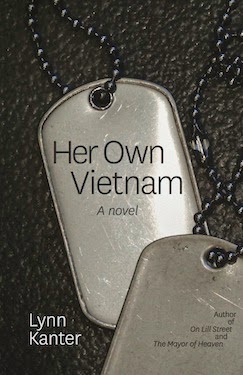
Her Own Vietnam Blog Tour


Always flattered to be a part of the Grab the Lapels blog tours because Melanie Page is doing such wonderful things to get writers the exposure and attention they deserve. In today's blog tour post,to celebrate Lynn Kanter's new novel, and to reach out to other women who have something to say about forgiveness and the past. Thank you to all the women who participated! To follow along with the rest of the tour, click here to see the schedule.


About Her Own Vietnam’s Main Character—

When Della Brown was 22 years old, she had just returned from a hellish year serving as a U.S. Army nurse in a combat hospital in Vietnam. During that time she had learned and lost much. She had made mistakes: errors of judgment, of inexperience. One mistake may have ended the life of a grievously injured soldier. Another cost Della her best friend. Thirty years later, Della was forced to confront those mistakes and find out whether she could learn to forgive: her country, her family, and most of all, herself.

Della is a fictional character in my novel Her Own Vietnam. But her dilemma is real. Many of us have made our own lives more difficult by holding onto grievances and regrets.


Looking back at your 22-year-old self, what would you counsel her about forgiveness?


“I would tell the 22-year-old me that she didn't have to try so hard to be who she wanted, that it was okay that she couldn't survive in New York City, that being an ‘artist’ didn't require anything in particular and that she should forgive herself for making choices that were about what she THOUGHT was right instead of what she felt was right.”
—Andi Cumbo-Floyd, Age 40


“You don't have to be perfect and neither does anyone else.”
—Heather Dorn, Age 37


“Dear Karen, You are going to meet a lot of people you think you want to have sex with. Most of them are not worth the effort of shaving your legs. You will convince yourself you are a free spirit, but you will spend hours agonizing over relationships that never really were relationships, and fretting that you never will have a real one, someone who loves you truly. Let me tell you, Karen, one day you will be loved. You will experience many of the things you dream of, and many things you do not. So spend this time before you find love, singing, writing, reading, dancing, and studying the natural world. Spend time in nature instead of seeking the elusive fantasy of a love that will save you. You're better off using this time to learn to make sushi, throw pottery, or bake pastry, than wasting one minute crying over lovers who never loved you.”
—Karen Lynch, Age 56


“You matter.”
—Lidia Yuknavitch, Age 51


“All those years of feeling awful about yourself were bullshit. You weren’t fat, you weren’t stupid, you weren’t ugly, and there were lots of people that really loved and admired you. There will be even more once you stop criticizing yourself so much and therefore are open to people. If you like yourself, it makes it much easier for others to warm up to you. The things that you care about and mean something to you are utterly valid. You’re very smart even though you got the message that this wasn’t true. If you’re the only one who is creative in your immediate sphere, you need to meet others who value this and don’t tell you you’ll never get a job. You don’t have to be with someone who doesn’t treat you well. You’re worth a lot more than that. Flirt, have fun, and bask in your youthfulness. When you meet someone who is going to treat you well, have fun with him or her. But keep doing the other things, too.”
—Bonnie ZoBell, Age 59


“You're worth caring for, and your care is valuable. And don't be so afraid all the time.”
—Beth Couture, Age 34


“There is nothing I could have said to save her from years of anger and blaming. She was not ready to hear the truth about relationships and taking personal responsibility for what she thought and how she behaved. The idea that she had choices about how she perceived herself and the world around her would have been completely foreign. If I had been able to tell her that what her mother taught her about her 'place' in society was all crap she might have gotten a glimpse into a different reality, but she would not have known what to do with it. She wanted to be right. To tell her that being right was not all that important if she also wanted to feel she was loved, would have undermined her foundation. It was her distorted foundation that propelled her forward to over achieve, to be the best, to be above criticism, to care about others, to do the work that needed to be done, to make her own mistakes. Therein, would evolve a new foundation in which forgiveness as her salvation was possible. Forgiveness releases us from the illusions of attack, condemnation, and blame and keeps us focused on love, for if we truly love, there is nothing to forgive. ‘Herein lies the peace of God’ (A Course In Miracles).”
—Merna Holloway, “Now, in the 71st year of my evolution”


“Dear Sheila: He's not worth you.”
—Sheila Squillante, Age 44


“Honestly, I don't think there's much she could hear, but I would keep showing up, being with her, listening and most of all LOVING her until she started to believe the truth that she is loved, she is lovely, that she doesn't need to try so hard - she is enough.”
—Kelly Hausknecht Chripczuk, Age 37


“Dump the handsome Irishman who makes you laugh but drinks too much and cheats on you and stay in school until you get your PhD. That nice Jewish boy will always love you, and he'll wait for you to finish yourself and forgive you when you show signs of asshatness. Grab him and hang on even if he isn't gorgeous. Beauty wanes, companionship will not. You're a bit shallow, my love, but I forgive you. No one knows everything at 22, and BTW, you do NOT always have to say exactly what's on your mind. Even if you're usually correct, you're dead right, and that does not endear you to others. Shut up and listen. Learn to be still.”
—Joani Reese, Age 57


“I consider regret a waste of emotional and physical energy.  Regret indicates you have not moved on and are not living in the present, or have not learned from your errors.  But forgiveness, on the other hand, is extremely important, and for the same reasons.  At 22 I was still blaming my relationship with my father for every sadness, heartbreak, ‘failure’ and embarrassment I experienced. Such bullshit. My father was, and is, simply who he is — not my ideal father but a flawed human being, like all of us.  (Well, perhaps a level of cruelty that verged on astonishing.)  At 22, I was old enough to take full responsibility for my behaviors and emotions, and their consequences. But blaming my father allowed me to avoid that responsibility.  I wonder (but do not regret) what decisions I would have made had I understood the freedom that resides in responsibility of self. It's a matter of curiosity now.  Too bad that wormhole into one or more lives of my multiverse isn't available.”
—Debra DeBlasi, Age 57


“I would tell that nervous little pony to forgive all those slights— both real and imagined—
because if she's done all her work by the time she's my age now, she's not going to remember them anyway, and because if she doesn't, they're going to settle in her shoulders, neck and gut and give her lots of pain and hold her back from following her dreams. I'd tell her keeping that stuff around and real wastes her time, energy and life.”
—Tracy DeBrincat, Age 54


Lynn Kanter is the author of the novels Her Own Vietnam (2014, Shade Mountain Press), The Mayor of Heaven (1997) and On Lill Street (1992), both published by Third Side Press. Her short fiction has appeared in the anthologies Lost Orchard (SUNY Press), Breaking Up is Hard to Do, and The Time of Our Lives: Women Write on Sex After 40 (both Crossing Press), and the literary journal Verbsap. Her nonfiction has appeared in Referential Magazine and the anthologies Coming Out of Cancer (Seal Press), Testimonies (Alyson Publications) and Confronting Cancer, Constructing Change(Third Side Press).


Lynn is a lifelong activist for feminist and other progressive causes, and has the T-shirts to prove it. Since 1992 Lynn has worked as a writer for the Center for Community Change, a national social justice organization. She lives with her wife in Washington, DC.